
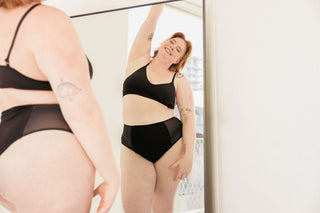
Well, let me take you on a trip down memory lane…
Early 2019, I started my personal quest (read: struggle) to find healthy underwear. I was dealing with regular flare-ups down under, and after a lot of confusing research, the consensus was clear: healthy underwear is crucial. Impulsive as I am, I headed straight to the mall.
A vibe killer called cotton
Okay, great. Now what? There I was. I knew which fabrics were unhealthy (sorry to burst your bubble, most of them 😅), but what exactly is healthy underwear? What does it look like? What is it made of? And where on earth do I find it?
After a few “Idk, Google it” type answers in the shops, cotton seemed to be the only way to go. "The cotton ones are in the back, near the pajamas." Literally that. Bye-bye feel-good vibes, bye-bye wanting to shop for lingerie. My only choice was one basic style in a 5-pack of dull, faded colors. Awesome...
My association with healthy underwear was anything but pleasant. I didn't feel good in it, it killed my morning vibe, and it only added to the insecurity I already felt due to my vaginal discomfort.
Healthy + eco + feel-good = mission impossible
Full of hope, I started my search for underwear that was healthier, ecological, AND felt good.
Cotton turned out to be healthy, but not eco-friendly. And personally, I wouldn’t call it "feel-good" either, to be honest. Why is cotton underwear not sustainable? Because cotton is heavily manipulated; there is simply not enough global supply to meet the massive demand of the polluting fast-fashion industry (I'm calling out the BS 👀).
I had to take a different direction. Not being ecological often goes hand in hand with being unhealthy, as toxic substances are usually added to create more cotton. Not on my watch.
Bamboo underwear: too good to be true?
I quickly stumbled upon bamboo underwear as an alternative. All the benefits sounded almost too good to be true. I started a crowdfunding campaign with bamboo as the theme and named my project Bamboost.
We got a lot of attention, which led to my collaboration with one of the most amazing women in my life: Annet Sunderman. Annet has been active in fashion for over 30 years and has spent the last few years specializing solely in fabrics. For those who already know me or Annet, you know I’m about to drop this name: she works for the Queen of the World herself: Queen B, Beyoncé, Yoncé. And the Kardashians *insert freak out* #truestory.
Together with Annet, I went all-in. We dug deep into the world of bamboo. Where does it come from? How is it harvested and turned into fabric? Who is involved in the supply chain? And how great is it, really? Turns out... it was too good to be true all along.
Why I pulled the plug on Bamboost
Bamboo has become incredibly popular in recent years, leading producers to churn out more and more of the fabric. They started using all kinds of dirty tricks to boost production. How much bamboo is actually left in your fabric? How ecological is your underwear if toxic chemicals are added to break down the bamboo faster? And how healthy can that be for our hoo-ha?
We decided to pull the plug in the summer of 2020. And thank god we did, because many bamboo brands are now being pulled from the shelves and products are being recalled.
Back to square one
Sigh. There we were again, desperately searching for a fabric that:
- absorbs to handle discomfort
- works preventatively
- is ecological
- is healthy
- breathes
- regulates the temperature down under.
Well... It also had to align with our values. Transparency is key. After a lot of research, a lot of digging, and many, many samples later, we finally saw the light: EcoVero™! A super-soft fabric that feels incredibly luxurious. HALLE-LU-JAH!
Why EcoVero™ actually works (and why you’ll want to wear it)
The fabric is made from sustainable wood and pulp (sourced from sustainable forestry 🌳). Almost all chemicals used in the production of EcoVero are recovered and reused. Compared to conventional viscose production, EcoVero creates 50% fewer emissions and uses half the energy and water. Nice!
And the benefits don’t stop there, on the contrary:
- ❤️ Exceptionally skin- and allergy-friendly
- ❤️ Breathable fabric
- ❤️ Absorbent and moisture-regulating
- ❤️ Intense colors that stay vibrant, even after frequent washing